


Industry News|Upgraded Overseas Procurement Standards Fuel Rising Imports of Industrial Antimicrobial Additives in Vietnam
Ho Chi Minh City Report
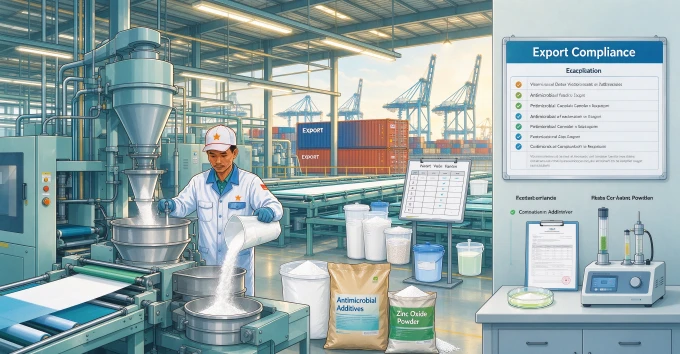
As Vietnam's export volumes of textiles‑garments, footwear, plastic daily‑use goods and children's stationery keep expanding, buyers from Europe, America, Japan and South Korea have incorporated antimicrobial & odour‑resistant performance, mould resistance and low heavy‑metal migration into mandatory technical purchasing requirements. A large number of export‑oriented manufacturers in Vietnam are scaling up imports of industrial antimicrobial raw materials. Restricted by the domestic fine‑chemical industry chain, Vietnam has few large‑scale manufacturers producing nano‑zinc oxide, silver‑based antimicrobial powder and textile antimicrobial finishing agents. Industrial functional antimicrobial chemical raw materials are mostly supplied through overseas imports.
Textiles‑garments, footwear, plastic products and student stationery form the core pillar of Vietnam's export‑driven economy, with finished products largely exported to the EU, the United States, the United Kingdom and Japan. Over the past two years, overseas brands no longer treat antimicrobial features as an optional marketing selling point, but embed them directly into order specifications. Sportswear, undergarments and hotel home‑textile fabrics require wash‑resistant antimicrobial performance to curb odours caused by sweat‑fed bacteria. For children's plastic stationery, infant articles and food‑contact plastic components, strict controls over heavy‑metal leaching are enforced, and zinc oxide antimicrobial powder has registered the sharpest consumption growth in these product categories. For local Vietnamese processors, non‑compliant antimicrobial‑safety test results may trigger full‑container rejections by destination countries overseas. Manufacturers would suffer combined losses covering goods, logistics and contract penalties, which compels producers to prioritise qualified imported antimicrobial additives to satisfy factory audits and shipment requirements.
In terms of local supply‑chain conditions, Vietnam boasts a certain pharmaceutical‑chemical industrial base, yet there is barely domestic mass‑production capacity for inorganic antimicrobial powder for plastics, textiles and stationery. Domestic plastic compounders, printing & dyeing mills and stationery factories source raw materials mainly via imports from two key origins: China and South Korea. Chinese zinc oxide antimicrobial powder, available in diverse particle‑size grades with strong cost‑performance, is well‑received by plastic compounding and stationery producers. South Korean suppliers hold a higher market share for silver‑based antimicrobials and pre‑formulated textile antimicrobial finishing liquids, which are widely preferred by many foreign‑invested OEM plants. Most local Vietnamese processors tend to import bulk antimicrobial powder and perform in‑house mixing to produce plastic masterbatches or textile finishing working solutions, instead of purchasing ready‑mixed finished additives.
From a regulatory perspective, Vietnam's revised Chemicals Law came into force in 2026. All imported inorganic and organic chemical products must go through import declaration via the national single‑window system, with complete MSDS and component documentation submitted. Incomplete paperwork will result in cargo detention and customs clearance delays. To date, Vietnam has not released comprehensive mandatory national standards specifically targeting industrial antimicrobial powder. Regulatory controls focus largely on finished goods. Domestic‑sold children's plastic articles, stationery and textile products must comply with QCVN national technical regulations covering formaldehyde, heavy metals, azo dyes and other indicators; however, mandatory certification for antimicrobial efficacy is not required. For export‑bound finished goods, local Vietnamese manufacturers bear full compliance liability and products must satisfy regulations including EU BPR, US EPA and relevant Japanese rules.
Qualified third‑party laboratories in Vietnam are limited. Institutions capable of delivering full test suites for antimicrobial rate, wash resistance and heavy‑metal migration are concentrated in Ho Chi Minh City and Hanoi, featuring long testing cycles and relatively high costs. Many small‑to‑medium processors cannot complete full verification locally after purchasing antimicrobial powder. They commonly rely on overseas raw‑material suppliers to provide third‑party test reports for factory‑audit submission to foreign buyers. This factor has become a vital benchmark when Vietnamese factories select suppliers.
The Vietnamese antimicrobial‑additive market shows obvious market segmentation. Large foreign‑invested factories and leading local export manufacturers serving European, American, Japanese and South‑ Korean clients attach high importance to batch consistency and safety indicators of antimicrobial powder and are willing to pay reasonable premiums for high‑quality raw materials. Small‑and‑medium‑sized processors targeting Vietnam's domestic market prioritise procurement prices with loose requirements for real‑world antimicrobial durability. Multiple locally sold daily‑use articles claim antimicrobial properties without supporting test data, relying heavily on concept‑driven marketing.
Industry analysts from the Vietnam Chamber of Commerce and Industry comment that the domestic antimicrobial‑additive market is typically export‑driven, with overseas order demands as the core growth engine. For local Vietnamese manufacturers, apart from raw‑material supply, overseas suppliers who can furnish complete test reports alongside technical process support - solving practical issues such as powder dispersion, mixing, masterbatch processing and textile finishing - stand a better chance of gaining recognition from local export‑oriented factories. Industry associations keep calling for the formulation of national standards for industrial antimicrobial materials and expansion of local laboratory antimicrobial‑testing capacity, so as to cut compliance costs for domestic export enterprises.